Dive into the luxurious world of Muga Silk of Assam, where golden threads from Brahmaputra’s wild silkworms weave stories of heritage and sustainability. Explore weaving villages and timeless crafts.

Hey, fellow wanderer! Picture this: you’re strolling along the misty banks of the Brahmaputra River, the air humming with the rhythmic clack of looms, and suddenly, a bolt of fabric catches the sunlight—like liquid gold draped over a weaver’s shoulder. That’s the magic of the Muga Silk of Assam, friends.

This isn’t just any silk; it’s Assam’s crown jewel, a shimmering testament to nature’s artistry and human hands. Today, we’re embarking on a cozy chat about this golden wonder. We’ll spill the craftsman’s secrets (shh, it’s all in the leaves!), guide you through its wild beginnings. Ready to unravel the threads? Let’s dive in.
First off, let’s talk roots of The Muga Silk of Assam

Akarsh Simha, CC BY-SA 2.0
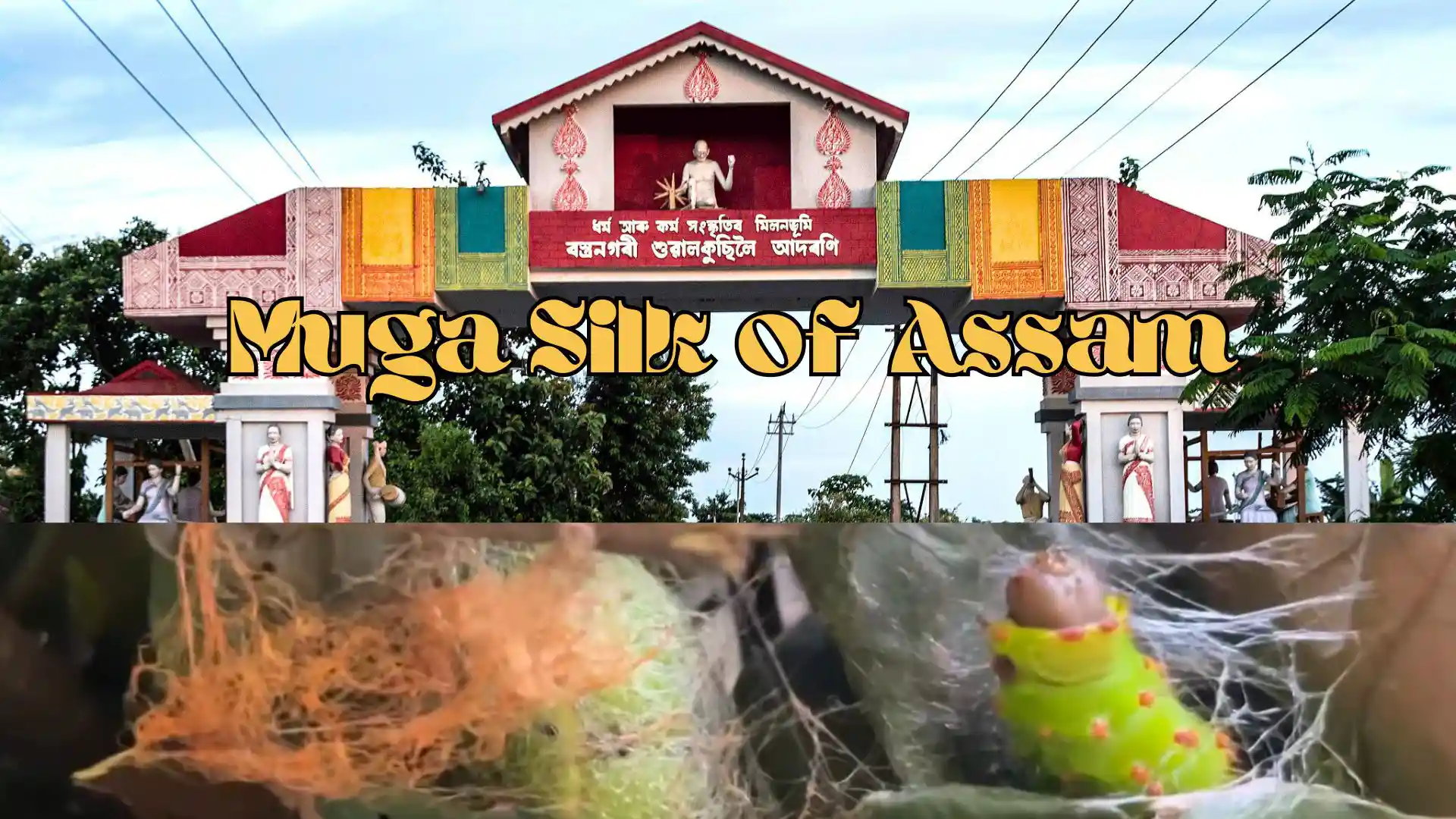
It’s life to the lush Brahmaputra Valley, where the mighty river cradles an ecosystem that’s as vital as it is vulnerable. The star players? The semi-wild Antheraea assamensis silkworms, munching exclusively on host plants like the som (Persea bombycina) and soalu (Litsea monopetala) trees. These evergreens thrive in the valley’s humid, subtropical embrace, their leaves infused with natural pigments that give the silk its iconic golden hue.

Imagine vast groves along the riverbanks, where fog-kissed mornings nourish these trees, and the silkworms—tiny architects—spin cocoons under the canopy. It’s a delicate dance: the valley’s monsoons provide the moisture, while the rich alluvial soil fuels growth. But here’s the ecosystem’s secret sauce, the one those master rearers guard like treasure:

Muga kolu – কুমুদ ঘোষ, CC BY 4.0
The silkworms’ diet from these specific plants creates a protein-rich silk that’s not just durable but naturally antimicrobial. No chemicals, just pure Brahmaputra bounty supporting over 22 secondary host plants in lean times. Without this harmony, the Muga Silk of Assam would fade like a forgotten dream.

Now, lean in closer—we’re about to reveal the craftsman’s hallowed secret: how these humble cocoons transform into fabric that glows brighter with every wash.

It starts in the rearer’s hut, where fresh cocoons are gently boiled in a brew of water, ash from pat (banana) leaves, and sometimes fermented rice water. This degumming softens the sericin (the sticky outer layer) without harming the delicate fibroin core.

Unwound by hand on simple reeling machines, the threads—each up to 900 meters long!—are twisted into yarn, dyed with natural roots and barks for those earthy tones, or left au naturel for the gold.

Then comes the weaving, on backstrap looms in dimly lit rooms, artisans interlace warp and weft with motifs inspired by Assam’s rivers and rhinos.

The real wizardry? That golden sheen isn’t painted on; it’s born from the host plants’ tannins, absorbed by the worms. And get this—the more you wash it (gently, with mild soap), the more the silk polishes itself, revealing a deeper luster that lasts generations. It’s like the fabric comes alive, whispering tales of resilience. No wonder it’s called “Assam silk” with a GI tag under Bharat Heritage—pure, protected, and priceless.

What do you do with such treasure? Oh, the garments! The Muga Silk of Assam drapes the soul of Assamese culture. For women, it’s the iconic mekhela chador:

a cylindrical skirt (mekhela) wrapped low on the hips, paired with a flowing upper wrap (chador) that doubles as a shawl—elegant for festivals like Bihu or weddings. Men rock gamosas (handkerchief-cum-turbans) or kurtas in this silk, while shawls and scarves add a luxe layer to modern wardrobes.
You can also read – Magic of Patalkot Valley: A Mysterious Place in MP

credit – Satnath
Think lightweight saris for summer soirées or stoles that shimmer under city lights. From traditional dokhonas to contemporary kurtis, the versatility is endless, all woven with motifs like the jaapi hat or gamusa patterns—each piece a canvas of heritage.

But beyond the beauty, let’s get real about the heartbeat: the people. The Muga Silk of Assam isn’t just craft; it’s lifeline. This industry employs over 100,000 rural families, from rearers in remote villages to weavers in bustling hubs, generating steady income where jobs are scarce.

Women, often the backbone, rear silkworms seasonally while men handle reeling—it’s a family affair boosting socio-economic status, with exports fetching premium prices globally. In a state where agriculture dominates, this golden thread weaves empowerment, funding education and healthcare for thousands.

Bhrigu bayan, CC BY-SA 4.0
Yet, every tale has shadows. The Muga Silk of Assam faces storms: climate change wreaks havoc with erratic monsoons scorching host plants, while pesticides from nearby farms poison the worms. Synthetic imitations flood markets, undercutting authentic prices, and the younger generation? They’re scrolling away from looms, lured by urban gigs—leaving skills on the brink. Conservation efforts, like government sapling drives, fight back, but it’s a race against time.

Jugal Bharali, CC BY-SA 4.0
So, where do we go from here? Pack your bags for Sualkuchi, the “Manchester of the East”—Assam’s throbbing silk village on the Brahmaputra’s north bank, home to 5,000+ looms churning Muga magic. Wander its satras (monasteries) for live demos, haggle in weaving co-ops, or hop to nearby Bhatiapar village for homestay looms. Best in winter (Oct-Mar), when the air’s crisp and markets buzz. Dip your toes in the river, chat with a weaver over chai, and snag a mekhela chador, your golden souvenir.

There you have it, traveler—the unveiled secrets of the Muga Silk of Assam. It’s more than fabric; it’s a living legacy calling you home. What’s stopping you? The Brahmaputra awaits. Safe journeys!
You may also follow and share you experiences on our official facebook page – Travelseek official facebook page